Japan travel professional with 15+ years of industry experience, including senior roles at major Japanese travel companies and media. Every recommendation in this guide is based on firsthand knowledge. We are never paid directly by hotels to feature them.
I’ve been sending travellers to Hakone’s hot springs for over 15 years, and I’ll say it plainly: Hakone is the single easiest place in Japan for a first-time onsen experience. Ninety minutes from Shinjuku, multiple distinct spring types, day-use options if you’re not staying overnight, and enough English-language infrastructure that you won’t feel completely lost. This guide gives you everything you need — the best areas, honest facility picks, etiquette explained simply, and timing advice based on what I’ve actually observed over many seasons.
🛁 Planning an onsen getaway near Tokyo? Check out our honest guide to the best onsen ryokans near Tokyo — covering Hakone, Izu, and Nikko.
TL;DR
- Best onsen area overall: Gora and Kowakudani for serious spring enthusiasts; Hakone-Yumoto if it’s your first time and you want easy access
- First-timer advice: Go midweek, book a facility with both private and communal baths, and arrive before 3 PM
- Best value day-use facility: Hakone Yuryo — book the private (kashikiri) bath in advance on Klook
*Disclosure: Some links in this article are affiliate links. If you book through them, I may earn a small commission at no extra cost to you. All recommendations are based on 15+ years in the Japan travel industry — no paid placements, ever.*
What Makes Hakone Onsen Special
Most places in Japan have onsen. What sets Hakone apart is the combination of geological variety, proximity to Tokyo, and the density of quality facilities within a relatively small geographic area. Within roughly 20 kilometres, you’ll find seven distinct spring types — from the alkaline colourless waters of Hakone-Yumoto to the milky sulphurous springs of Kowakudani. That variety, compressed into a single easily navigable region, is what makes Hakone worth the trip even for people who’ve soaked in springs elsewhere in Japan.
The Water Types
Hakone’s springs are often described as having nine distinct source areas (泉源地), each producing slightly different water chemistry. In practical terms for visitors, the key variations are:
Sodium bicarbonate (重曹泉) — Hakone-Yumoto, Tonosawa: Colourless, slightly alkaline water that feels soft and silky on the skin. Often called “bijin-no-yu” (beautiful skin water) because of its mild cleansing effect. This is the most accessible and the most common spring type you’ll encounter in the lower Hakone areas.
Sulphur spring (硫黄泉) — Kowakudani, Owakudani area: The milky-white water that looks slightly like diluted milk. The distinctive egg-smell (hydrogen sulphide) is the giveaway. These springs are associated with skin benefits — particularly for eczema and dry skin conditions. The colour comes from suspended sulphur particles, not impurities.
Calcium sulphate (石膏泉) — Gora, Miyanoshita: Slightly astringent, colourless to pale yellow. Often recommended for those with sensitive skin. Many of Gora’s finest ryokans draw from these springs.
Sodium chloride (食塩泉) — Sengokuhara: Salty springs that warm the body from the inside out and are said to retain heat long after you’ve left the bath. Good for circulation and joint discomfort.
In reality, many Hakone facilities blend waters from multiple sources or pipe water from a nearby source rather than drawing directly on-site. The spring type will be displayed (often in Japanese) at the facility entrance. If water quality is important to you, ask or look it up before booking.
Open-Air Baths (Rotenburo) vs. Indoor Baths
This is one of the most common questions I get from first-timers.
Indoor baths (内湯 / uchiyū): Sheltered, temperature-controlled, and comfortable year-round. Indoor baths at quality facilities are typically tiled stone or wooden tubs in a large, well-ventilated room. The experience is more controlled and easier for newcomers to navigate.
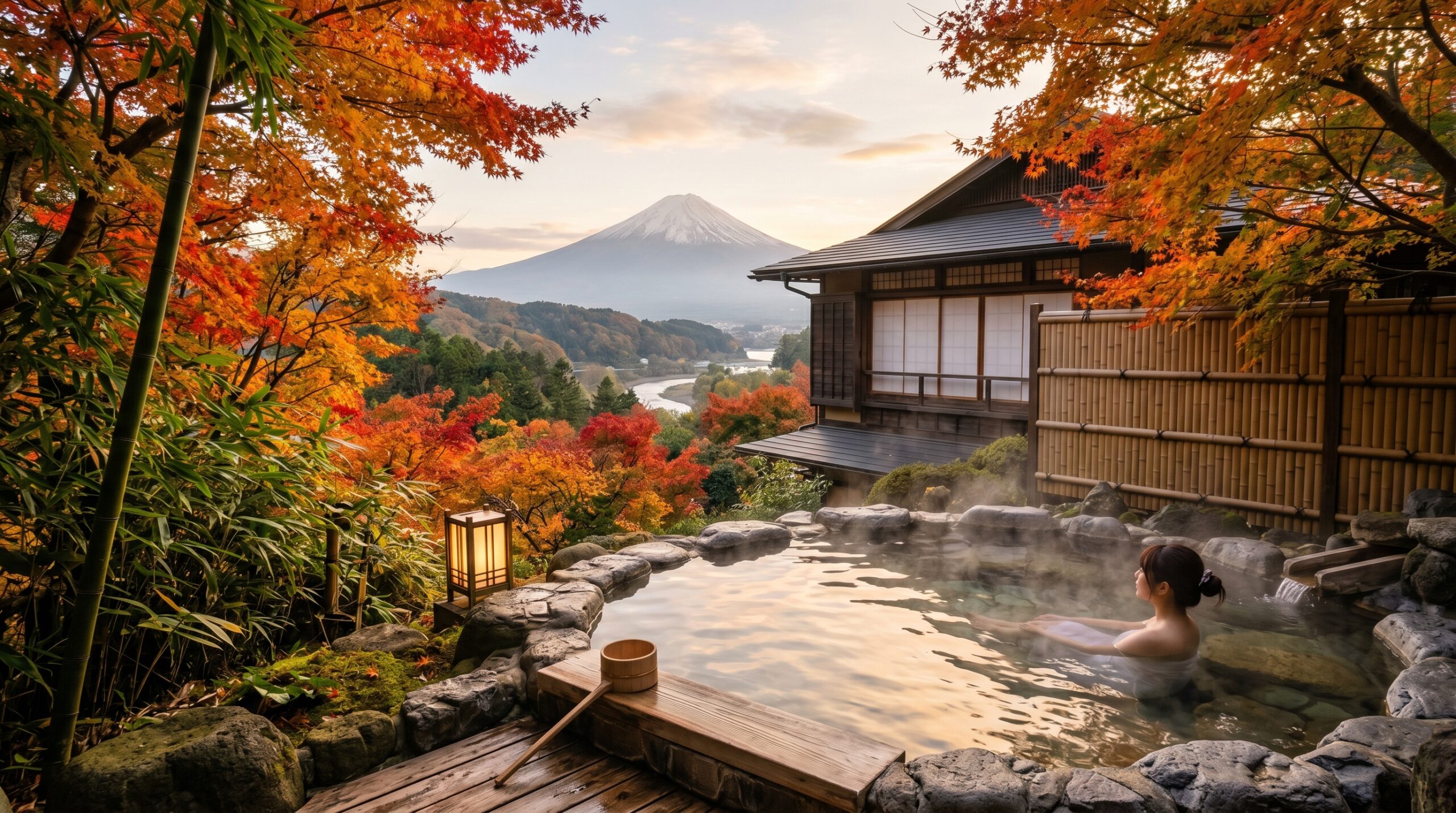
Open-air baths (露天風呂 / rotenburo): Outdoors, partially or fully exposed to the elements. This is what most people imagine when they think of a Japanese hot spring. In winter, soaking in a steaming outdoor bath while cold air hits your face is an experience that’s genuinely difficult to describe to someone who hasn’t done it. In summer, evening rotenburo under stars is equally special. The trade-off is variable weather and, at crowded times, more exposure.
My recommendation: if you can only do one, do a rotenburo, and do it in autumn (October–November) or winter (December–February). These are the seasons where the contrast between the hot water and cool air is most pronounced — and the most memorable.
Best Onsen Areas in Hakone
Hakone-Yumoto
The entry point to the Hakone area and the most accessible onsen district. Hakone-Yumoto station sits at the base of the valley, and the town has been a hot spring destination since the Edo period. The surrounding streets are busy with ryokans, souvenir shops, and day-use facilities.
Spring type: Primarily alkaline sodium bicarbonate — colourless, soft on the skin.
Best for: First-timers; late arrivals who want to be near transport; short stays with limited time for exploring the wider area.
What to expect: This is the most touristy of Hakone’s spring areas, which is both a positive (English signage, easy logistics) and a negative (crowds on weekends and holidays). Water quality is good but not exceptional compared to higher-altitude springs.
Gora
Halfway up the mountain, reached by the Hakone Tozan Railway (the adorable switchback train that climbs in zigzags). Gora is home to a botanical garden, the Hakone Open Air Museum nearby, and several of Hakone’s finest ryokans.
Spring type: Calcium sulphate and mixed springs — colourless, slightly astringent, excellent for skin.
Best for: Serious onsen enthusiasts; couples wanting a quieter, more refined stay; anyone planning to visit the Hakone Open Air Museum.
What to expect: A slower pace than Yumoto. The elevated position means cooler temperatures, which makes the rotenburo experience particularly rewarding. Gora is also well-connected — the Tozan Railway runs frequently and connects to the ropeway for onward travel to Owakudani and Lake Ashi.
Kowakudani
A distinct area reached via the Hakone Tozan Cablecar (different from the ropeway — this is the short cable car between Gora and Sounzan). Kowakudani is the site of a geothermal valley where you can see steam rising from the ground.
Spring type: Sulphurous, milky white — the most visually distinctive springs in Hakone.
Best for: Those who specifically want sulphur springs; anyone staying at Hakone Kowakien Tenyu or similar properties with private baths.
What to expect: Slightly harder to get to than Gora or Yumoto, which keeps crowds lower. The milky white water is striking and the sulphur smell is unmistakable — if that bothers you, this isn’t your area. If you love the look and feel of these springs (and many people do), it’s worth the extra travel time.
Sengokuhara
The highland area in the western part of Hakone, famous for pampas grass fields (susuki) in autumn and a more rural, resort-like atmosphere. Getting around requires buses, which run on a schedule.
Spring type: Sodium chloride springs — warming, good for circulation.
Best for: Travellers seeking quiet and nature over convenience; autumn visitors (the pampas grass is spectacular in October); guests at KAI Sengokuhara or the Hyatt Regency Hakone.
What to expect: Less crowded than the main tourist areas. The landscape feels more open and rural — a genuine contrast to Gora or Yumoto. Bus dependency means you’ll want to plan your movements in advance.
Day-Use Onsen in Hakone
You don’t need to stay overnight to experience Hakone’s springs. Several excellent facilities offer day-use (日帰り温泉) access, where you pay an entry fee to use the baths for a set period.
Hakone Yuryo
My consistent recommendation for day-use. Designed in a traditional Japanese aesthetic, well-maintained, and unusual in that it offers both communal baths and private “kashikiri” baths that can be reserved by the hour. The private baths mean it’s accessible to tattooed visitors (more on that below) and to anyone who prefers a solo soak.
Hours: Generally 10:00 AM – 9:00 PM (last entry 8:00 PM). Verify before visiting as hours can change seasonally.
Getting there: About 10 minutes by bus from Hakone-Yumoto station.
Tip: Book the private bath on Klook in advance — they fill up quickly on weekends and holidays.
Yunessun
A more resort-style facility near Kowakudani that includes both traditional onsen baths and a water park zone with various themed pools (including, famously, a wine bath and sake bath). This is the fun option — less authentic traditional experience, more spectacle and variety.
Best for: Families with children; groups who want variety over authenticity; younger travellers.
Tenzan Tohji-kyo
A well-regarded facility in Hakone-Yumoto that offers a more rustic, nature-immersed experience. The outdoor baths are built into the hillside along a river, and the setting is genuinely beautiful. Mixed reviews on the weekday-vs-weekend experience, but midweek it’s one of the more atmospheric options in the area.
Getting there: A short walk from Hakone-Yumoto station; slightly upstream along the river.
Tattoo policy: Communal baths prohibit tattoos. No private bath option.
Other Day-Use Options
Several of Hakone’s ryokans also offer day-use access to their onsen facilities (called “日帰り温泉プラン”). Quality is typically higher than dedicated day-use facilities, and you may have access to the same spring water used by overnight guests. Check directly with properties like Yumoto Fujiya Hotel or Hakone Hotel Kowakien for current day-use availability and pricing.
Onsen Ryokans in Hakone
For the full onsen experience — overnight, with access to both indoor and outdoor baths, kaiseki dinner, and the quiet that comes with waking up in a mountain ryokan — see the detailed guide:
Best Ryokans in Hakone: Honest Picks by a Japan Travel Expert →
For detailed picks across all budgets — including honest pros and cons for each property — see our dedicated guide: Best Ryokans in Hakone: Honest Picks →
Onsen Etiquette for First-Timers
Japan’s onsen culture has a set of practices that can feel intimidating if you’re unfamiliar. They’re not complicated once you understand the logic. Here’s what you actually need to know.
How to Use an Onsen Properly
1. Shower before entering the bath. Every onsen has shower stations (washing areas with shower heads, small stools, and soap/shampoo). You must wash your body thoroughly before entering the communal bath. This isn’t optional — it’s the fundamental rule that makes communal bathing work.
2. Enter without a towel. You’ll have a small modesty towel (tenugui), but it stays out of the water. Either hold it or fold it on your head — the classic Japanese hot spring look that actually has a practical purpose (it keeps the towel from trailing in the water).
3. Lower yourself slowly. Onsen water is genuinely hot — often 40–42°C (104–108°F). If you’ve been standing in the cold, getting in fast can be uncomfortable. Take your time.
4. Don’t stay too long. First-timers often underestimate how draining hot spring bathing is. 15–20 minutes per soak is plenty. Rest, hydrate, go back in if you want.
5. Rinse off before leaving. A quick shower after is standard practice.
6. Stay hydrated. Drink water before and after — the mineral content and heat together are dehydrating.
Tattoo Policy
The majority of Hakone onsen facilities prohibit tattoos in communal baths. This is a longstanding cultural policy (related to historical associations between tattoos and organized crime in Japan). It is not directed at foreign visitors specifically — it applies to everyone.
Your options if you have tattoos:
- Book a ryokan room with a private in-room bath. Most properties allow tattooed guests to use their own private bath even if the communal areas are off-limits. Confirm with the property directly.
- Use a day-use facility with private kashikiri baths, like Hakone Yuryo. The private bath option is available to tattooed guests.
- A small number of Hakone facilities are explicitly tattoo-friendly in all areas — search “tattoo-friendly onsen Hakone” to find current options.
- Waterproof cover patches (防水シール) are allowed at some properties but not all. Do not assume — ask in advance.
→ For a full list of tattoo-friendly properties and private day-use baths: Hakone Private Onsen Guide
What to Bring / What’s Provided
Provided at most facilities:
- Towels (large bath towel and small tenugui) — either included or available for a small rental fee
- Body soap and shampoo at shower stations
- Yukata (at overnight ryokans)
- Hair dryers in changing rooms
What to bring:
- Your own toiletries if you have preferences (skincare, specific shampoo)
- A toothbrush — ryokans typically do not provide these
- Comfortable shoes for walking between facilities/rooms in yukata
- Hairbands or clips if you have long hair (hair must be kept out of the water)
When to Visit Hakone for Onsen
Autumn (October – November) — Peak Season
The most popular time to visit, and for good reason. Autumn foliage (koyo) is spectacular in Hakone, particularly around Gora, the Tozan Railway route, and the pampas grass fields of Sengokuhara. The combination of autumn colours and steaming outdoor baths is what you see in all the photographs. Book 2–3 months in advance for ryokans during this period.
Winter (December – February) — Best for Onsen
Counterintuitively, winter is my favourite season for a Hakone onsen trip. Crowds are significantly lower than autumn, prices drop at many properties, and the experience of soaking in a steaming outdoor bath with cold air on your face — especially if it snows — is extraordinary. Clear winter days also offer the best Mt. Fuji views from Lake Ashi. January and February can be quite cold at altitude (Gora, Sengokuhara), so pack accordingly.
Spring (Late March – Early May) — Cherry Blossoms
Cherry blossom season brings significant crowds to Hakone, particularly around Hakone-Yumoto and along the Tozan Railway. The blossoms along the railway route are beautiful, and the combination with onsen is appealing. Expect busy facilities, premium prices, and the need to book well ahead. Golden Week (late April – early May) is extremely crowded — not recommended unless you book months in advance.
Summer (June – August) — Rainy Season, Then Crowds
June is rainy season — hydrangeas bloom beautifully along the Tozan Railway, crowds are lower, and prices are accessible. Outdoor baths in light rain have a particular atmosphere. July and August bring summer crowds and heat, which changes the rotenburo dynamic (less of a contrast between air and water temperature). Summer is a reasonable time to visit but not the best.
How to Get to Hakone from Tokyo
The standard approach is the Odakyu Romancecar from Shinjuku, which runs directly to Hakone-Yumoto in about 85 minutes. Seats are reserved and the journey is comfortable — this is the route I recommend for first-timers.
For a full breakdown of all routes, timing, costs, the Hakone Free Pass, and getting around within Hakone once you arrive:
Complete Tokyo to Hakone transport guide →
FAQ
Can you do a day trip for onsen in Hakone?
Yes, absolutely. Multiple facilities in Hakone offer day-use onsen access (日帰り温泉) with entry fees ranging from around ¥1,500 to ¥3,500 depending on the facility. Hakone Yuryo and Yunessun are the most visitor-friendly for day-trippers. Hakone-Yumoto is about 85 minutes from Shinjuku by Romancecar, making a same-day return trip entirely practical. If you want to use an outdoor bath, arrive in the afternoon when the light and temperature combination is most enjoyable.
Are Hakone onsen tattoo friendly?
Most communal baths in Hakone prohibit tattoos, as is standard across Japan. However, tattooed visitors have workable options: book a room with a private in-room rotenburo at a ryokan, or use a day-use facility that offers private kashikiri baths (Hakone Yuryo is the most accessible). A small number of facilities are explicitly tattoo-friendly in communal areas — these are increasing but still a minority. Always confirm the specific policy with the facility before visiting.
What type of water is Hakone onsen?
Hakone has several spring types depending on the area. The most common are sodium bicarbonate (colourless, soft, skin-softening — found in Hakone-Yumoto and Tonosawa), sulphur springs (milky white, distinctive egg smell — found in Kowakudani), calcium sulphate (slightly astringent, colourless — found in Gora), and sodium chloride (warming, salty — found in Sengokuhara). The spring type is displayed at each facility; if you have a preference or skin condition, this is worth checking before booking.
Is Hakone onsen good for skin?
Yes, most Hakone spring types have recognised skin benefits. The sodium bicarbonate springs common in Hakone-Yumoto are specifically known as “bijin-no-yu” (beautiful skin water) due to their mild cleansing and softening effect on the skin surface. The sulphur springs of Kowakudani are associated with benefits for dry skin and eczema. Regular soaking in mineral-rich spring water does demonstrably improve skin moisture retention and texture for most people — though individual results vary and the effects are cumulative rather than immediate.
*Last updated: May 2026. Facility hours, pricing, and policies are subject to change. Verify directly with each facility before visiting.*