Japan travel professional with 15+ years of industry experience, including senior roles at major Japanese travel companies and media. Every recommendation in this guide is based on firsthand knowledge. We are never paid directly by hotels to feature them.
Finding a ryokan in Kyoto with a private onsen sounds simple — but it’s actually one of the trickier accommodation searches in Japan. Kyoto’s city center has limited natural hot spring sources, so “private onsen” here means different things depending on the property. This guide cuts through the confusion and gives you honest picks across every budget.
TL;DR Quick Picks:
- Best Overall: HOTEL THE MITSUI KYOTO → Check availability on Agoda

- Best Luxury Ryokan: Suiran, a Luxury Collection Hotel (Arashiyama) → Check availability on Agoda

- Best Mid-Range: nol Kyoto Sanjo → Check availability on Agoda

- Best Budget: Inari Ohan → Check availability on Agoda
- What “Private Onsen” Really Means in Kyoto
- How to Choose: Key Questions to Ask Before Booking
- Luxury Picks (¥80,000+/night per person)
- Mid-Range Picks (¥20,000–¥60,000/night per person)
- Budget-Friendly Picks (under ¥20,000/night per person)
- Worth Considering: Natural Hot Spring Areas Near Kyoto
- Day-Use Private Onsen in Kyoto
- How to Get to Kyoto
- When to Visit Kyoto
- Booking Tips
- FAQ
- Final Thoughts
What “Private Onsen” Really Means in Kyoto
Before diving into picks, this needs to be said: Kyoto is not a hot spring town in the traditional sense.
Unlike Hakone or Beppu — where natural geothermal water flows abundantly — Kyoto’s city center has almost no natural hot spring sources. That means many “onsen” experiences in Kyoto city hotels involve one of two things:
- Imported mineral water: Thermal water trucked in or piped from Yunohana Onsen (a hot spring village about 25km northwest of central Kyoto) and heated on-site.
- Kashikiri (貸切風呂): A shared onsen bath that you can reserve for exclusive private use during a time slot — typically 30–60 minutes.
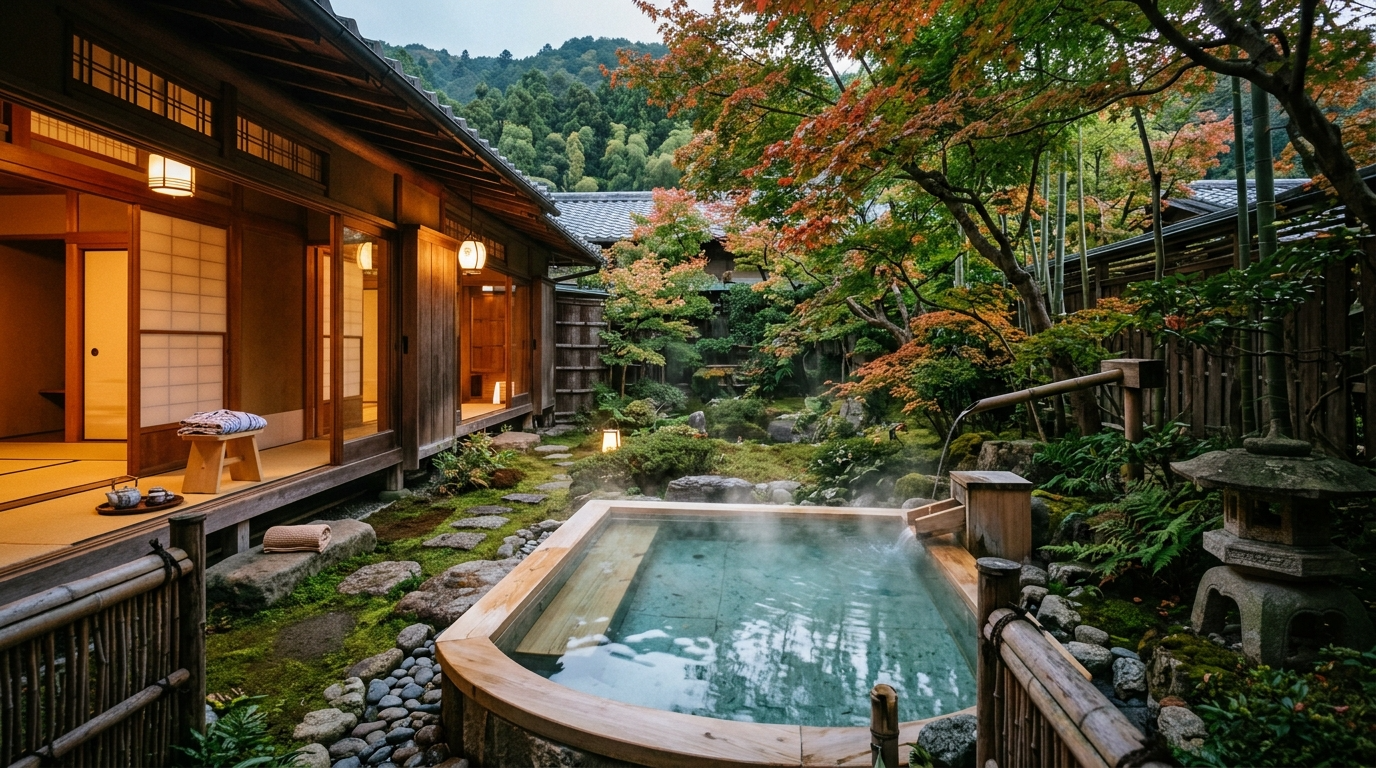
- In-room private bath (部屋付き露天風呂): A dedicated outdoor or indoor bath attached to your room, filled with either hot spring water or mineral water. The most sought-after option.
True natural hot spring ryokans with in-room private onsen are mostly found outside central Kyoto — in Yunohana Onsen, Kurama Onsen, or further out in Arashiyama. I’ll flag which category each property falls into.
How to Choose: Key Questions to Ask Before Booking
Is the water actually hot spring water? Ask the property directly. Look for “温泉” (onsen) certification — properties with certified natural hot spring water are legally required to display their spring analysis. If it’s “mineral bath” water, it’s not the same experience, though still relaxing.
Private bath vs. kashikiri? In-room private baths give you flexibility at any time. Kashikiri requires advance reservation and you’re often limited to one session per stay. Both can be worth it depending on your priorities.
What’s included in the rate? Kyoto ryokans almost universally offer two meal plans: dinner + breakfast (2 meals), or room-only. The kaiseki dinner is often the highlight of the stay — factor that into your value comparison.
Tattoo policy? More Kyoto ryokans are relaxing their tattoo rules, but it’s still worth checking. Properties in the Nazuna group are explicitly tattoo-friendly.
Luxury Picks (¥80,000+/night per person)
HOTEL THE MITSUI KYOTO
Location: Nijo Castle area (Central Kyoto)
Bath type: In-room private onsen (natural hot spring — one of the few in central Kyoto)
Price range: ¥100,000–¥200,000+/night per person
HOTEL THE MITSUI KYOTO opened in 2020 on the site of the former Mitsui family estate near Nijo Castle. It’s technically a hotel rather than a traditional ryokan, but the experience — particularly the suites with private outdoor onsen — rivals any ryokan in Japan.
What makes it exceptional: the property sits on a certified natural hot spring source. The private outdoor baths in premium suites are filled with actual geothermal water. The design balances traditional Japanese aesthetics with modern luxury. Kaiseki dining at the on-site restaurant is outstanding.
The catch: this level of experience comes at a price. Budget a minimum of ¥120,000 per person per night for the suites with private onsen.
Check availability on Agoda
Suiran, a Luxury Collection Hotel
Location: Arashiyama
Bath type: In-room private onsen (riverside setting)
Price range: ¥80,000–¥150,000/night per person
Suiran sits right on the Oi River in Arashiyama, with some rooms offering private open-air baths with direct river views. The setting — bamboo groves, the Togetsu-kyo Bridge, seasonal foliage — is arguably the most beautiful of any luxury accommodation in Kyoto.
It’s a Marriott Luxury Collection property, which means Western-standard amenities alongside Japanese traditions. The blend works here: tatami rooms are available, but so are Western-style beds if you prefer. Kaiseki dinner uses seasonal Kyoto ingredients.
One note: Arashiyama itself uses water from the Yunohana Onsen area for its baths rather than on-site natural springs.
Check availability on Agoda
Fufu Kyoto
Location: Higashiyama
Bath type: In-room private open-air bath
Price range: ¥70,000–¥130,000/night per person
Fufu Kyoto is a newer entry in the luxury ryokan space, positioned near the traditional machiya townhouse districts of Higashiyama. Every room has a private open-air bath. The atmosphere is intimate and quiet — this isn’t a large resort but a carefully curated boutique experience.
The location puts you within walking distance of Kiyomizu Temple, Ninenzaka, and the Gion district. Fufu has a reputation for exceptional kaiseki meals that focus on Kyoto’s seasonal kyo-yasai (Kyoto vegetables).
Check availability on Agoda
Nazuna Kyoto Higashi Honganji
Location: Downtown Kyoto (near Kyoto Station)
Bath type: In-room private bath + communal onsen (kashikiri available)
Price range: ¥60,000–¥120,000/night per person
The Nazuna group has become one of the more interesting players in the Kyoto luxury ryokan market. They operate several machiya-style properties across Kyoto, all with a modern sensibility while maintaining traditional layouts.
Two standout features: all Nazuna properties are tattoo-friendly, and they’re located in renovated machiya townhouses, meaning you’re staying in 100-year-old architecture that’s been carefully updated. The in-room private baths use mineral water rather than natural hot spring water, but the intimate atmosphere compensates.
Check availability on Agoda
Mid-Range Picks (¥20,000–¥60,000/night per person)
nol Kyoto Sanjo
Location: Sanjo area (Central Kyoto)
Bath type: In-room private bath (mineral water)
Price range: ¥25,000–¥55,000/night per person
nol Kyoto Sanjo is one of the best-value options for guests who want a private bath experience in central Kyoto without the eye-watering luxury tier price. The design is contemporary Japanese — clean lines, quality materials, thoughtful layout. Each room has a private bath.
The location on Sanjo-dori gives you excellent access to both the historic Gion area to the east and the Nishiki Market area to the west. The property doesn’t serve kaiseki in-house, but the neighborhood has excellent restaurant options.
For couples visiting Kyoto who want the private bath experience but are prioritizing budget for experiences (temples, restaurants, day trips), nol Kyoto Sanjo hits a good balance.
Check availability on Agoda
Ryokan Motonago
Location: Higashiyama
Bath type: Kashikiri private onsen (reservable)
Price range: ¥25,000–¥50,000/night per person
Motonago is a traditional ryokan in the heart of the Higashiyama sightseeing district. It doesn’t have in-room private baths for every room, but it offers kashikiri (reserved private use) of its onsen facilities.
The charm here is authenticity: this is a proper old-school Kyoto ryokan with tatami rooms, futon bedding, yukata robes, and seasonal kaiseki meals. The location is excellent — you’re steps from Yasaka Shrine and the traditional stone-paved lanes of Ninenzaka.
Best for: travelers who prioritize location and traditional atmosphere over having a dedicated private bath in-room.
Check availability on Agoda
Tazuru
Location: Central Kyoto (riverfront)
Bath type: In-room private bath with river views
Price range: ¥30,000–¥60,000/night per person
Tazuru is a small boutique ryokan with rooms overlooking the Kamogawa River. The private baths with river views are the highlight — particularly in the evening when the riverbank lanterns reflect off the water.
The property is intimate (small number of rooms), kaiseki dinner is served in-room, and the service is attentive. A solid choice for couples wanting a romantic Kyoto experience with private bath access.
Check availability on Agoda
Gion Ryokan Q-beh
Location: Gion
Bath type: In-room private bath (some rooms)
Price range: ¥20,000–¥45,000/night per person
Located in the atmospheric Gion district, Ryokan Q combines a traditional exterior with comfortable, modern interiors. Select rooms have private in-room baths. The Gion location means you’re close to Hanamikoji Street (the iconic geisha district), Yasaka Shrine, and the Higashiyama walking route.
Value proposition: this is one of the more affordable options that still delivers a genuine ryokan experience in a top-tier Kyoto neighborhood.
Check availability on Agoda
Budget-Friendly Picks (under ¥20,000/night per person)
Inari Ohan
Location: Fushimi (near Fushimi Inari Shrine)
Bath type: In-room private bath
Price range: From ¥13,000–¥18,000/night per person
Inari Ohan is one of the most-recommended affordable ryokans with private bath access in the Kyoto area. It’s located in Fushimi, about 20 minutes by train from central Kyoto — which is both its limitation and its charm.
The tradeoff is worthwhile if you’re planning to visit Fushimi Inari Shrine early morning before the crowds arrive. The accommodation itself is modest but genuine: tatami rooms, futon bedding, a simple breakfast. The private bath uses standard heated water rather than natural hot spring water.
For budget-conscious travelers who want the private bath experience without the luxury price, this is the most honest pick in the list.
Check availability on Agoda
Kyonoyado Gekkoan
Location: Central Kyoto
Bath type: Kashikiri private bath (reservable at additional fee)
Price range: ¥15,000–¥25,000/night per person
Gekkoan is a machiya-style guesthouse that offers a private bath option for guests willing to pay a small supplement. The accommodation has the classic Kyoto townhouse aesthetic — narrow facade, internal garden, wooden beams — at a price point accessible to travelers who aren’t aiming for full luxury.
Note that the “private bath” here is kashikiri-style (reserved time slot), not a dedicated in-room facility.
Check availability on Agoda
Worth Considering: Natural Hot Spring Areas Near Kyoto
If experiencing genuine natural hot spring water is a priority, consider basing yourself outside central Kyoto:
Yunohana Onsen (湯の花温泉)
25km northwest of central Kyoto. Small, quiet hot spring village with traditional ryokans. Several properties offer private onsen rooms. Less touristed than Arashiyama and genuinely relaxing. Ideal if you’re visiting Arashiyama and don’t mind a rural setting.
Kurama Onsen (鞍馬温泉)
30 minutes north of central Kyoto by train. Famous for outdoor baths surrounded by cedar forest. Day use is popular, but overnight stays are available. The natural setting is dramatic — particularly in autumn.
Kyo Yunohana Resort Suisen
Location: Yunohana Onsen area
Bath type: Natural hot spring, in-room private outdoor onsen
Price range: ¥50,000–¥100,000/night per person
If you’re willing to go slightly outside the city for genuine natural hot spring water, Suisen is an excellent choice. The property draws certified hot spring water, rooms have private outdoor baths, and the mountain setting is genuinely beautiful. Recommended for guests who want the full traditional onsen ryokan experience rather than a city-center convenience.
Check availability on Agoda
Day-Use Private Onsen in Kyoto
Not staying overnight but want the private onsen experience? Several options exist:
Funaoka Onsen: Historic public bathhouse in the Kinkakuji area. Traditional rather than luxury, but genuinely atmospheric. No private bath option, but an authentic Kyoto bathing experience.
Kurama Onsen Day Use: ¥2,500–¥3,500 for outdoor bath access. No private reservations, but the natural setting is exceptional.
Some ryokans listed above (particularly Motonago and certain Nazuna properties) offer day-use private bath reservations — contact them directly.
How to Get to Kyoto
Kyoto is well-connected by Shinkansen from Tokyo (approximately 2 hours 20 minutes on the Nozomi). From Osaka, it’s 15 minutes by Shinkansen or 30 minutes by limited express. If you’re combining Kyoto with other cities, consider a JR Pass for flexible travel.
For temple visits, most of Kyoto’s major sights are accessible by bus or on foot from central accommodation. The Higashiyama area in particular is best explored on foot.
(Full Kyoto travel guide coming soon)
When to Visit Kyoto
Spring (late March–early April): Cherry blossom season. Extraordinary but very crowded. Book ryokans 3–6 months in advance minimum for this period.
Autumn (mid-November): Autumn foliage. Equally beautiful, equally crowded. Similar advance booking required.
Summer (July–August): Hot and humid. Gion Matsuri Festival in July is spectacular. Fewer overseas tourists than spring/autumn.
Winter (December–February): Quieter, cooler temperatures, and occasional snow on temple rooftops. Best season for ryokan value — rates drop significantly and availability opens up.
Shoulder seasons (May–June, September–October): Best combination of reasonable crowds, good weather, and fair pricing.
Booking Tips
Book early for peak seasons: Cherry blossom (late March–early April) and autumn foliage (mid-November) require 3–6 months advance booking for private onsen ryokans. Some properties open reservations exactly 6 months ahead — set a calendar reminder.
Check the meal plan: Most ryokans quote per-person rates inclusive of dinner and breakfast. This is usually the best value — kaiseki meals at comparable standalone restaurants cost ¥15,000–¥30,000 per person. Factor this in when comparing “room-only” and “with meals” rates.
Communicate dietary restrictions in advance: Kyoto kaiseki uses seasonal vegetables, tofu, and seafood — it’s naturally accommodating of many dietary needs. However, severe allergies or vegetarian/vegan requirements require advance notice.
Ask about the bath type explicitly: Email or call the property before booking to confirm whether the “private onsen” in your room uses certified natural hot spring water, imported mineral water, or is kashikiri-style.
FAQ
What is the difference between ryokan and hotel in Kyoto?
A ryokan is a traditional Japanese inn with tatami rooms, futon bedding, yukata robes, and multi-course kaiseki meals. Hotels offer Western-style amenities and beds. Many Kyoto luxury properties blend both — HOTEL THE MITSUI KYOTO, for example, is technically a hotel but offers a traditional Japanese experience. Traditional ryokans tend to be smaller, more intimate, and more focused on culinary experience.
Do all Kyoto ryokans have onsen?
No. Kyoto has limited natural hot spring sources. Many ryokans offer mineral baths, imported spring water, or kashikiri reservable baths rather than dedicated in-room natural onsen. Always confirm the bath type before booking.
How much does a Kyoto ryokan with private onsen cost?
Expect ¥40,000–¥200,000+ per person per night, including two meals (dinner and breakfast). Budget-friendly options with kashikiri access start around ¥15,000–¥20,000 per person, but true in-room private onsen rooms start from approximately ¥25,000 per person at mid-range properties.
Are Kyoto ryokans tattoo-friendly?
It varies. Public bath facilities at most traditional ryokans prohibit tattoos. However, if you have a private in-room bath (not a shared facility), tattoos are typically a non-issue since you’re the only one using it. The Nazuna group explicitly markets itself as tattoo-friendly for both private and communal facilities.
How far in advance should I book a Kyoto ryokan?
For peak seasons (cherry blossom in late March–early April, autumn foliage in mid-November), book 3–6 months ahead. For off-peak months, 4–8 weeks is usually sufficient for most properties. The most exclusive properties like HOTEL THE MITSUI KYOTO and Suiran can fill up 6+ months in advance for weekend dates year-round.
Can I do a day trip to Kyoto and still experience a private onsen?
Yes, via day-use options. Kurama Onsen (30 min north by train) offers outdoor bath access for walk-in visitors. Some central Kyoto ryokans offer kashikiri day-use reservations — contact properties directly.
Final Thoughts
Kyoto’s private onsen ryokan scene is genuinely excellent — but it requires more research than equivalent searches in Hakone or other dedicated hot spring towns. The key distinction to keep in mind: in-room private onsen (the most sought-after experience) vs. kashikiri reservable baths vs. mineral water baths.
If budget is flexible, HOTEL THE MITSUI KYOTO and Suiran Arashiyama are the standouts. For mid-range travelers, nol Kyoto Sanjo delivers excellent value with private bath access in a central location. For a genuinely authentic traditional experience, Ryokan Motonago in Higashiyama remains one of the most honest picks in Kyoto regardless of price tier.
The real secret for experiencing natural hot spring water near Kyoto: venture slightly outside the city center to Yunohana Onsen or Kurama. Fewer crowds, lower prices, and genuine geothermal water.
This guide was written by a Japan travel professional with 15+ years of experience, including senior roles at major Japanese travel companies and media. Every recommendation is based on industry knowledge and firsthand research — never paid placements.
Related guides: