Japan travel professional with 15+ years of industry experience, including senior roles at major Japanese travel companies and media. Every recommendation in this guide is based on firsthand knowledge. We are never paid directly by hotels to feature them.
Japan travel professional with 15+ years of industry experience, including senior roles at major Japanese travel companies and media. Every recommendation in this guide is based on firsthand knowledge. We are never paid directly by hotels to feature them.
Searching for “private onsen Kyoto” returns a lot of results — but most of them are selling you an overnight ryokan stay that costs ¥80,000+ per person. What if you want the private bath experience without committing to a full luxury ryokan night?
This guide is for that situation. It covers:
- Day-use private bath options in and around Kyoto
- What “private onsen” actually means in Kyoto (it’s not what you might think)
- Kashikiri (貸切風呂) — the reserved private bath format most visitors don’t know about
- Tattoo-friendly options
If you’re looking for overnight ryokan recommendations with private onsen, see our dedicated guide: Best Kyoto Ryokan with Private Onsen.
- TL;DR Quick Picks
- The Honest Reality: What “Private Onsen” Means in Kyoto
- Onsen Etiquette for Private Baths
- Day-Use Private Onsen Options Near Kyoto
- Historic Sento Worth Visiting in Kyoto City
- Kashikiri: The Private Onsen Format Most Visitors Miss
- Tattoo-Friendly Private Onsen in Kyoto
- How to Get to Kurama Onsen from Kyoto
- FAQ
- Final Thoughts
TL;DR Quick Picks
| Best For | Pick |
|---|---|
| Best day-use private bath near central Kyoto | Funaoka Onsen (sento, no private option) → combine with Gokouyu for variety |
| Best day-use natural onsen with private option | Kurama Onsen (30 min from city) |
| Best half-day onsen resort | Kyo Yunohana Resort Suisen (40 min from city) |
| Best kashikiri in the city | Arashiyama Onsen Kadensho |
| Best for tattoos (day-use) | Kyo Yunohana Resort Suisen (private room option) |
Disclosure: I’ve spent 15+ years working in Japan’s travel industry. I recommend based on industry knowledge and research — never paid placements. Some links are affiliate links; I earn a small commission if you book through them, at no extra cost to you.
The Honest Reality: What “Private Onsen” Means in Kyoto
Before booking anything, you need to understand one key fact: Kyoto city center has almost no natural hot spring water.
Unlike Hakone or Beppu — where geothermal springs flow abundantly — Kyoto sits on a geological basin that produces very little natural spring activity. When a Kyoto hotel or ryokan advertises a “private onsen,” it typically means one of three things:
Type 1: In-Room Private Bath (部屋付き露天風呂)
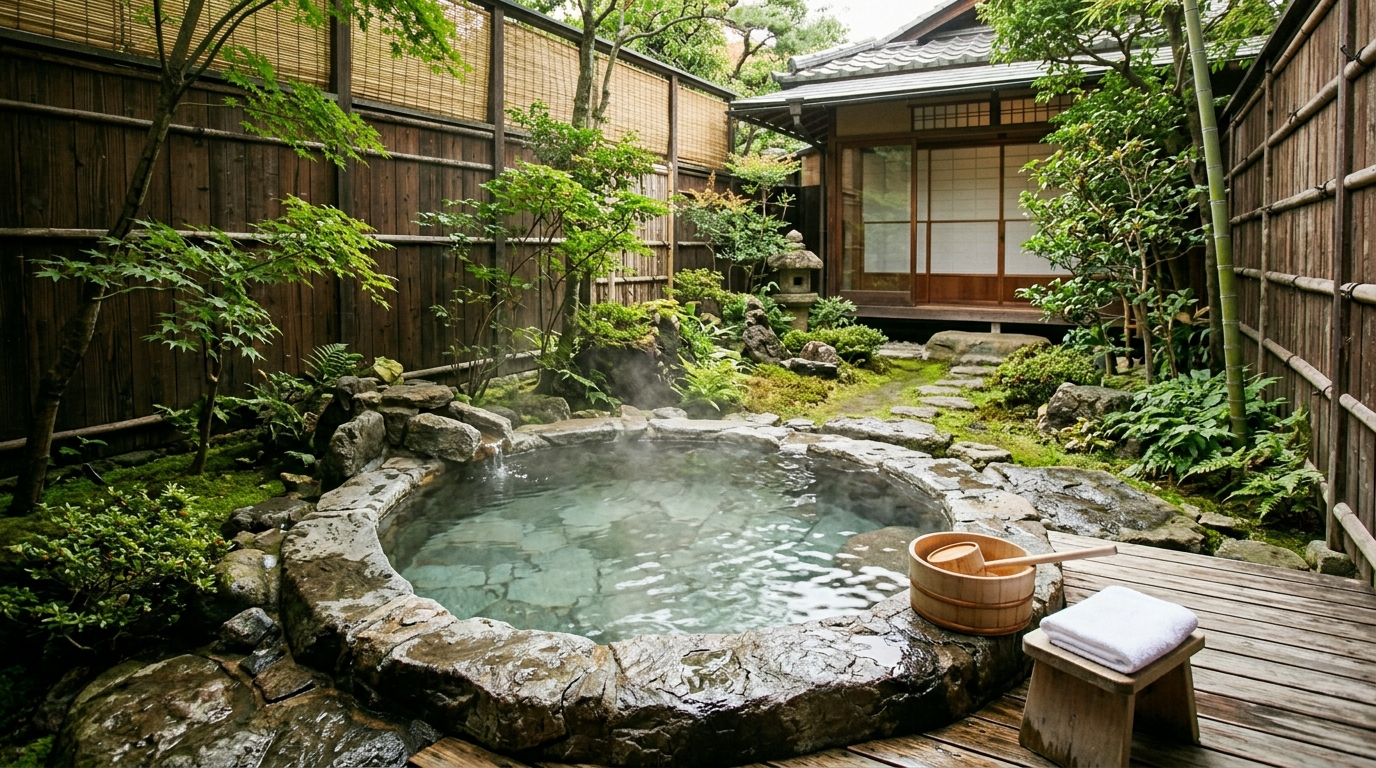
A dedicated tub in your room — often hinoki (Japanese cypress) or ceramic. The water is usually soft water or mineral-enhanced water, not a natural hot spring. You have full access at any time during your stay. This is the most convenient and most expensive option, and it’s almost exclusively available with overnight ryokan bookings.
→ For overnight options, see: Best Kyoto Ryokan with Private Onsen
Type 2: Kashikiri / Kazoku-buro (貸切風呂)
A communal bath you reserve exclusively for your group — typically 30–60 minutes per session. Some ryokans include this free for guests; others charge ¥1,000–¥3,000/session. Day-use facilities also offer this format. Crucially: kashikiri is often available to non-staying visitors, which makes it the most practical private onsen option in Kyoto for day trippers.
Type 3: Actual Natural Hot Spring (本物の温泉)
Rare inside the city. Certified natural hot spring sources in the Kyoto area are mostly found in Arashiyama, Kurama (north of the city), and Yunohana (Kameoka, ~40 minutes west). If real geothermal water matters to you, you’ll need to travel slightly.
The good news: A well-run kashikiri or a hinoki-tub day session is a genuinely luxurious experience even without certified spring water. The ritual of a private Japanese bath — the steam, the wood, the quiet — holds regardless of the geological source.
Onsen Etiquette for Private Baths
Even in a private bath, some rules apply:
- Shower first — rinse off before entering any bath, even a private one
- No soap or shampoo in the tub — wash at the shower station, then soak clean
- Hair up — tie long hair back before entering
- No phones — leave them outside (and respect other guests if others will use the facility after you)
- Time limits — kashikiri sessions have set durations; check the rules when you arrive
Day-Use Private Onsen Options Near Kyoto
1. Kurama Onsen — Best Natural Hot Spring Day Trip
Distance from central Kyoto: 30 minutes by Eizan Railway from Demachiyanagi Station
Natural hot spring: ✅ Yes
Private bath (kashikiri): ❌ No reserved private baths — communal only
Tattoos: ❌ Not permitted in communal baths
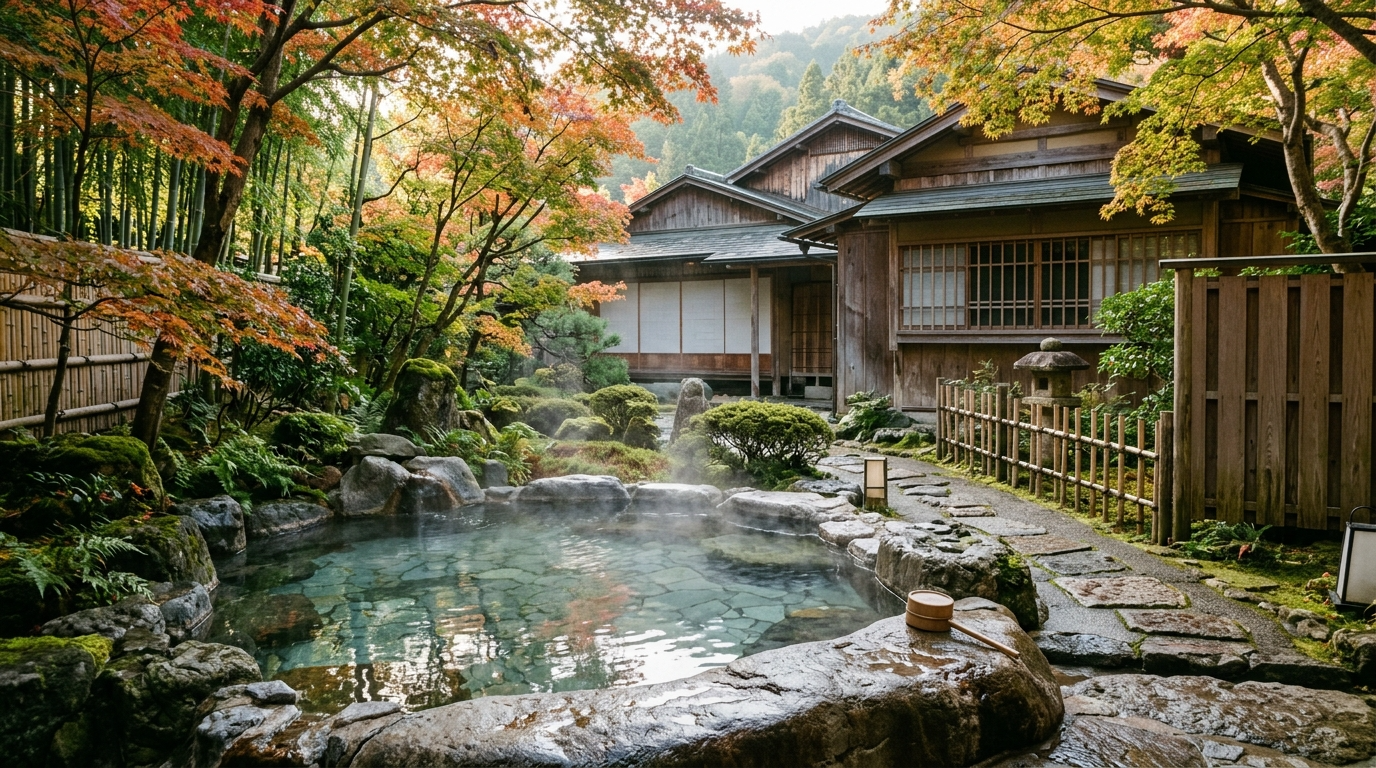
Kurama Onsen is the most accessible genuine hot spring from Kyoto. The outdoor baths overlook cedar-forested mountains and are spectacular in autumn. The water is sodium bicarbonate type — noticeably silky on the skin.
There are no private bath reservations here, but if you’re going with a partner and tattoos aren’t a concern, the outdoor rotenburo is worth the 30-minute train ride. Combine with a hike up to Kurama Temple for a full half-day.
- Outdoor bath only: ¥1,000 adults / ¥700 children
- Indoor + outdoor set: ¥2,500 adults (includes towel and yukata)
- Hours: 10:00 AM – 9:00 PM daily
- Access: Eizan Railway Kurama Line → Kurama Station → 10-min walk or free shuttle
2. Kyo Yunohana Resort Suisen — Best Full Onsen Resort Day Use
Distance: ~40 minutes west of Kyoto (JR San’in Line to Kameoka, then shuttle)
Natural hot spring: ✅ Yes (sodium chloride type)
Private bath (kashikiri): ✅ Yes — private rooms available
Tattoos: ✅ Private room option accommodates tattooed guests
Yunohana Onsen is one of the oldest hot spring areas in the Kyoto region — over 1,200 years of history. The Suisen resort offers both public baths and reservable private rooms (kashikiri with natural hot spring water), which makes it the best day-use option for anyone who:
- Has tattoos
- Wants a private soak without booking overnight
- Wants confirmed natural hot spring water
Day-use plans vary seasonally; check their website for current pricing. Free shuttle from Kameoka Station.
Check availability on Agoda
3. Arashiyama Onsen Kadensho — Best Kashikiri in Arashiyama
Distance: Arashiyama, western Kyoto (30–40 min from city center)
Natural hot spring: ✅ Yes (Arashiyama spring water)
Private bath (kashikiri): ✅ Yes — 5 private baths
Tattoos: ✅ Accommodated in private baths
Kadensho, located in front of Hankyu Arashiyama Station, offers five reservable private hot spring baths in addition to communal baths. The no-nakai (no attending staff) policy gives guests full privacy. The spring water is known for relieving muscle pain and improving skin quality.
Day-use plans are available depending on availability. Contact the property directly to confirm. Booking well in advance is recommended — especially on weekends.
Check availability on Agoda
4. Ohara: Yumoto Onsen Oharasansou — Most Secluded Option
Distance: ~1 hour north of central Kyoto (bus or car)
Natural hot spring: ✅ Yes
Private bath (kashikiri): ✅ Available
Tattoos: Confirm in advance
Ohara is a mountain village that feels entirely separate from Kyoto’s tourist bustle. Sanzen-in Temple is the main draw. Oharasansou’s baths use natural spring water from the mountain area, and private bath reservations are available. The autumn foliage here is particularly beautiful.
This is not a convenient day trip — plan a half-day at minimum. Best for travelers who want to combine an onsen soak with a quieter, less-visited side of Kyoto.
Check availability on Agoda
Historic Sento Worth Visiting in Kyoto City
If you’re staying in central Kyoto and can’t easily travel to an onsen, these public bathhouses (sento) are genuinely worth visiting. They’re not natural hot springs, but they’re a significant piece of Kyoto’s living culture.
Funaoka Onsen — Most Historic Bathhouse in Kyoto
Operating since the 1920s, Funaoka Onsen is the bathing equivalent of a living museum. Its interior features intricate carved ceilings, green tiles, and an atmosphere preserved from pre-war Kyoto. In 1933 it became the site of Japan’s first denkiburo (electric bath).
No private baths available, but if you want to experience a genuine Kyoto neighborhood bathhouse, this is it.
- Admission: ~¥500–600
- Hours: Mon–Sat 3:00 PM – 1:00 AM; Sunday 8:00 AM – 1:00 AM
- Location: Kita Ward, north Kyoto
- Note: Bring your own towel and toiletries, or purchase on-site
Gokouyu — Best Variety of Bath Types
Celebrating 90+ years of operation, Gokouyu in Sakyo Ward offers radium mineral baths, electric baths, herbal medicinal baths, and ganbanyoku (heated bedrock bathing). No private baths, but one of the best spots for trying multiple Japanese therapeutic bath types in a single visit.
- Hours: Weekdays 2:30 PM – 12:30 AM; Sunday 7:00 AM – midnight
- Closed: Mondays and 3rd Tuesday of the month
Kashikiri: The Private Onsen Format Most Visitors Miss
Many travelers focus on either “full public bath” or “luxury overnight private bath” — and miss the middle option: kashikiri (貸切風呂), a communal bath reserved exclusively for your group.
Here’s what you need to know:
How it works: You reserve a specific time slot (usually 30–60 minutes) for your group only. You have the entire bath to yourselves. No strangers, no communal nudity anxiety.
Cost: Usually ¥1,000–¥5,000 per session at most facilities, sometimes free with an overnight stay.
Tattoo policy: Kashikiri is where most tattooed visitors can enjoy an onsen experience even at traditionally strict properties. Since you’re alone in the bath, the “no tattoos in communal baths” rule often doesn’t apply.
Availability: Not all facilities offer kashikiri. Those that do often require advance booking — sometimes weeks ahead for peak seasons.
Who it’s for: Couples, families with small children, guests with tattoos, anyone who wants a more private experience than a communal bath provides.
Tattoo-Friendly Private Onsen in Kyoto
Tattoo policies remain one of the most common frustrations for foreign visitors to Japanese onsen. Here’s the honest picture for Kyoto:
| Facility | Tattoo Policy |
|---|---|
| Kyo Yunohana Resort Suisen | ✅ Private rooms available |
| Arashiyama Kadensho | ✅ Private baths accommodate tattoos |
| Nazuna Kyoto (any property) | ✅ Explicitly tattoo-friendly (overnight stays) |
| Kurama Onsen | ❌ Communal baths only, no tattoos |
| Funaoka Onsen | ❌ Traditional public bath, strict rules |
General rule: Any kashikiri or in-room private bath is almost always more accommodating than communal baths. When in doubt, email the property directly before booking.
How to Get to Kurama Onsen from Kyoto
The easiest natural hot spring day trip from Kyoto:
- Go to Demachiyanagi Station (accessible by subway Karasuma Line to Kitaoji, then bus; or walk from central Kyoto)
- Take the Eizan Railway Kurama Line to Kurama Station — about 30 minutes, ¥430 one way
- From Kurama Station: 10-minute walk to the onsen, or take the free shuttle
Combine with: Kurama Temple (30-minute hike up the mountain) for a full half-day experience.
FAQ
Can I do a private onsen in Kyoto without staying overnight?
Yes. Kyo Yunohana Resort Suisen (Kameoka, ~40 min) and Arashiyama Kadensho both offer day-use kashikiri private bath reservations. Contact them directly to book.
What is kashikiri?
Kashikiri (貸切風呂) is a communal bath reserved exclusively for your group — typically for 30–60 minutes. You have the entire facility to yourselves. It’s the most practical way to experience a private Japanese bath without paying for an overnight luxury ryokan.
Is there a day-use private onsen close to central Kyoto?
Not really in the city center itself. The most convenient options are in Arashiyama (~30 min) or Kurama (~30 min by train). For a truly close option, sento like Funaoka Onsen and Gokouyu offer communal bathing (not private) in central Kyoto.
Can I use an onsen in Kyoto if I have tattoos?
Yes, if you choose the right facility. Kashikiri and in-room private baths are your best options — most allow tattoos since you’re not sharing with other guests. Kyo Yunohana Suisen and Arashiyama Kadensho are explicitly noted as accommodating tattooed guests in private baths. Traditional communal facilities (Kurama Onsen, Funaoka) enforce no-tattoo policies.
Does Kyoto have natural hot spring water?
Very little in the city center itself. The main natural hot spring areas near Kyoto are: Kurama (north, 30 min by train), Arashiyama (west, uses water from Yunohana area), and Yunohana Onsen in Kameoka (west, ~40 min). For more detail on the onsen geography, see our Kyoto Onsen Guide.
How much does a private onsen experience in Kyoto cost?
- Kashikiri day-use session: ¥2,000–¥8,000
- Day-use admission at onsen resort: ¥1,000–¥3,000 (communal baths)
- Overnight ryokan with in-room private bath: ¥20,000–¥200,000+ per person (with meals)
Final Thoughts
The “private onsen in Kyoto” search often leads travelers toward expensive overnight ryokan packages — which are wonderful, but not the only option. For day visitors and budget-conscious travelers, kashikiri at Arashiyama Kadensho or a half-day trip to Kyo Yunohana Suisen are genuinely satisfying alternatives.
If you’re planning an overnight stay and want curated private onsen ryokan picks, see: Best Kyoto Ryokan with Private Onsen.
For the broader hot spring scene in and around Kyoto (including Kurama and Arashiyama overnight options), see: Kyoto Onsen Guide.
Last updated: May 2026. All prices are approximate and subject to change.